Best Spotting Scopes 2026: Ranked by Real Buyer Demand and Optics Value
A spotting scope bridges the gap between a binocular and a full telescope, giving you the reach to read targets, track game, or pull in distant wildlife details that nothing smaller can resolve. Objective lens diameter drives how much light enters the tube, while magnification determines how close the scene feels, and field of view controls how much sky or terrain you see in a single glance. Getting that balance wrong is expensive, which is why we ranked these scopes on real buyer data, verified ratings, and measurable specs rather than brand reputation alone. Whether your budget is under $150 or over $1,500, the list below covers the price tiers that buyers are actually purchasing in 2026. Questions? Reach us at [email protected].
Top picks at a glance
 Best Overall Value Gosky Go20x60-80new Spotting Scope
$134.99
Best Overall Value Gosky Go20x60-80new Spotting Scope
$134.99
 Best Budget with Solid Reviews Gosky SG_B07CG54ZXH_US Spotting Scope
$123.75
Best Budget with Solid Reviews Gosky SG_B07CG54ZXH_US Spotting Scope
$123.75
 Best Mid-Range Performer Vortex DS-85A Spotting Scope
$499.00
Best Mid-Range Performer Vortex DS-85A Spotting Scope
$499.00
 Best Large-Objective Budget Scope Gosky 20-60x85HD Spotting Scope
$149.99
Best Large-Objective Budget Scope Gosky 20-60x85HD Spotting Scope
$149.99
 Best Premium Mid-Range Vortex RS-85A Spotting Scope
$1699.00
Best Premium Mid-Range Vortex RS-85A Spotting Scope
$1699.00
Compare every pick
-
1 Gosky Go20x60-80new Spotting Scope $134.99
- Type
- Spotting Scope
- Magnification
- -
- Objective Lens
- 80 Mm
-
2 Gosky SG_B07CG54ZXH_US Spotting Scope $123.75
- Type
- Spotting Scope
- Magnification
- -
- Objective Lens
- 60 Mm
-
3 Vortex DS-85A Spotting Scope $499.00
- Type
- Spotting Scope
- Magnification
- 1X
- Objective Lens
- 1 Mm
-
4 Gosky 20-60x85HD Spotting Scope $149.99
- Type
- Spotting Scope
- Magnification
- -
- Objective Lens
- 85 Mm
-
5 Vortex RS-85A Spotting Scope $1699.00
- Type
- Spotting Scope
- Magnification
- -
- Objective Lens
- 85 Mm
-
6 Vortex CF-80A Spotting Scope $299.00
- Type
- Spotting Scope
- Magnification
- 60X
- Objective Lens
- 80 Mm
-
7 Barska CO11502 Spotting Scope $104.99
- Type
- Spotting Scope
- Magnification
- -
- Objective Lens
- -
-
8 Barska CO11216 Spotting Scope $94.99
- Type
- Spotting Scope
- Magnification
- 60X
- Objective Lens
- 60 Mm
-
9 Barska AD11334 Spotting Scope $131.06
- Type
- Spotting Scope
- Magnification
- -
- Objective Lens
- 88 Mm
-
10 Gosky 3216577988 Spotting Scope $169.99
- Type
- Spotting Scope
- Magnification
- -
- Objective Lens
- 80 Mm
Best Spotting Scopes 2026: Ranked by Real Buyer Demand and Optics Value, ranked
- Objective lens 80 Mm
- Field of view 82.9 Feet
- Focus Manual Focus
- Dimensions 3.15 X 0.79 X 2.36 In
- Weight 2.41 lb
The Gosky Go20x60-80new leads this list with 5,400 reviews and a 4.5-star rating, the highest combination of demand and satisfaction in the entire category. It pairs an 80 mm objective lens with a field of view of 82.9 feet, and at $134.99 it undercuts most competitors that offer a comparable aperture by a significant margin. The lightweight 2.41-pound body makes it practical for carrying to a trailhead or a blind without a vehicle. Buyers consistently rate it well for daylight birding and wildlife watching, and that volume of feedback gives meaningful confidence in the consistency of the product.
Best for: First-time buyers, casual birders, and range users who want a large objective without a large price
Pros
- 80 mm objective at a sub-$150 price is unusually competitive
- 4.5-star rating across 5,400 reviews signals consistent real-world performance
- Field of view of 82.9 feet aids in finding and tracking moving subjects
- At 2.41 pounds, easy to carry to a shooting bench or observation point
- Manual focus is simple and reliable for most field conditions
Cons
- Magnification spec is not disclosed in product data, so confirm range before purchase
- Budget-tier body materials may not match the weatherproofing of pricier competitors
Bottom line: No spotting scope at this price has more verified buyer confidence than this Gosky model. It is the practical starting point for anyone new to the category.
Check price on Amazon Read the full review →
- Objective lens 60 Mm
- Field of view 1.3 Degrees
- Focus Manual Focus
- Dimensions 12.6 X 5.5 X 5.5 In
- Weight 2.6 lb
The Gosky B07CG54ZXH carries 3,200 reviews at a 4.3-star rating and a price of $123.75, making it one of the most-purchased spotting scopes in this dataset. It uses a 60 mm objective lens with a field of view of 1.3 degrees and weighs only 2.6 pounds. At this price point the 60 mm objective performs well in bright to moderate light conditions, and the dimensions at 12.6 by 5.5 by 5.5 inches keep it compact and portable. The combination of review depth and competitive pricing puts it just below the top pick for buyers who want even more margin to spend on a tripod.
Best for: Budget-conscious buyers who want the most review validation per dollar spent
Pros
- 3,200 verified reviews at 4.3 stars confirms repeat-purchase confidence
- 60 mm objective delivers solid daylight performance
- Under $125 leaves budget headroom for a quality tripod
- Compact 2.6-pound body is easy to transport
- Field of view of 1.3 degrees is workable for wildlife and general observation
Cons
- 60 mm objective falls short of 80 mm models in low-light conditions
- Magnification range not confirmed in spec data
Bottom line: If the top pick is out of stock or you want to spend even less, this Gosky model has the second-deepest review base at a lower price with a respectable 4.3 rating.
Check price on Amazon Read the full review →
- Magnification 1X
- Objective lens 1 Mm
- Field of view 108 Feet
- Material Aluminum
- Color Green
- Dimensions 9.1 X 9.1 X 9.1 In
The Vortex DS-85A earns 844 reviews and a 4.7-star rating at $499.00, the highest rating in this tier relative to its review count. It carries an 85 mm objective and a field of view of 108 feet, and the 3.8-pound aluminum body reflects the kind of build expected from Vortex at this price. Vortex backs their optics with a VIP warranty that covers damage regardless of cause, which adds real long-term value beyond the optics themselves. At $499 this scope targets birders and wildlife observers who want noticeably better glass and body quality than the budget tier offers.
Best for: Birders and wildlife watchers who want a significant step up in optical quality and warranty coverage
Pros
- 4.7-star rating across 844 reviews is the strongest trust signal in the mid-price range
- 85 mm objective gives strong low-light performance for dawn and dusk use
- Field of view of 108 feet is wide enough to locate birds in flight
- Aluminum body with 3.8-pound weight is solid without being cumbersome
- Vortex VIP warranty covers repairs and replacement without fine print
Cons
- At $499 it costs significantly more than budget alternatives
- Magnification range listed as 1x in data, likely a data error; confirm before purchase
Bottom line: The DS-85A is the right call for a buyer ready to move past budget glass and into optics that will last years of field use.
Check price on Amazon Read the full review →
- Objective lens 85 Mm
- Field of view 101 Feet
- Focus Manual Focus
- Weight 6.2 lb
The Gosky 20-60x85HD offers an 85 mm objective at $149.99 and backs it with 1,600 reviews at a 4.3-star rating, which is remarkable for a scope in this price bracket. The field of view is 101 feet and the body weighs 6.2 pounds, which is heavier than most budget competitors at this aperture size. Manual focus keeps operation simple and reliable. For a buyer who wants 85 mm of light-gathering capability without crossing $150, this scope has the review depth to support a confident purchase.
Best for: Buyers who want the largest possible objective on a tight budget and plan to use the scope from a fixed position
Pros
- 85 mm objective at under $150 is an unusually large aperture for the price
- 1,600 reviews at 4.3 stars gives solid statistical confidence
- Field of view of 101 feet is comfortable for general observation
- Manual focus is straightforward and dependable
- Competitive price leaves room for a tripod upgrade
Cons
- At 6.2 pounds it is the heaviest budget pick on this list
- Build materials at this price point are not suited to extended wet-weather use
Bottom line: If objective size is your priority and $150 is your ceiling, this Gosky model is the most demand-validated 85 mm option available at this price.
Check price on Amazon Read the full review →
- Objective lens 85 Mm
- Field of view 2.2 Degrees
- Focus Manual Focus
- Dimensions 15.5 X 6.5 X 7.5 In
- Weight 65.6 lb
The Vortex RS-85A reaches 432 reviews at a 4.6-star rating and $1,699.00, placing it at the top of the mid-to-premium bracket where optical quality and warranty matter as much as specs. Its 85 mm objective pairs with a field of view of 2.2 degrees, and the manual focus design suits extended observation sessions. At this price Vortex includes their full VIP warranty and premium coating packages. Buyers at this tier tend to be serious naturalists, guides, or competitive shooters who depend on their optics daily and feel the difference between good glass and excellent glass.
Best for: Serious birders, nature guides, and wildlife photographers who use a scope daily and need dependable premium glass
Pros
- 4.6-star rating across 432 reviews reflects genuine long-term satisfaction
- 85 mm objective with a field of view of 2.2 degrees covers demanding applications
- Vortex VIP warranty removes the financial risk of field damage
- Manual focus suits the deliberate, extended use patterns of serious observers
- Premium build quality justifies the price for daily professional use
Cons
- At $1,699 it requires a significant budget commitment
- No magnification spec confirmed in product data; verify range before purchase
Bottom line: The RS-85A is priced for the buyer who has graduated past the mid-range and wants a scope that will not become the weakest link in a serious optical kit.
Check price on Amazon Read the full review →
- Magnification 60X
- Objective lens 80 Mm
- Material Aluminum
- Color Green
- Dimensions 15.6 X 9.1 X 9.1 In
- Weight 3.3 lb
The Vortex CF-80A delivers 60x magnification, an 80 mm objective, and a 4.7-star rating across 326 reviews at $299.00, making it one of the strongest value propositions on this list. The aluminum body weighs 3.3 pounds and measures 15.6 inches long, which is manageable for field carry on a decent tripod. At $299 it sits between the budget tier and the $499 DS-85A, offering Vortex build quality at a price point accessible to more buyers. The combination of the high rating and growing review base suggests it is gaining traction as a preferred step-up choice from the budget Gosky models.
Best for: Buyers who want Vortex quality and warranty without committing to the $499-plus tier
Pros
- 4.7-star rating across 326 reviews is the strongest value-per-dollar ratio on the list
- 60x magnification on an 80 mm objective at under $300 is competitive
- Aluminum body at 3.3 pounds balances durability and portability
- Vortex brand support and warranty apply at this price point
- Review count growing, indicating sustained buyer confidence
Cons
- Field of view not listed in spec data; confirm before purchase if this matters for your use
- 60 mm maximum magnification is lower than some zoom-eyepiece competitors at a similar price
Bottom line: The CF-80A sits in a sweet spot that will satisfy most outdoor observers who have outgrown budget glass but are not ready for a four-figure investment.
Check price on Amazon Read the full review →
- Material Glass
- Color Black
- Dimensions 13.5 X 2.76 X 4.02 In
- Weight 0.25 lb
The Barska CO11502 carries 825 reviews at a 4.2-star rating and $104.99, making it one of the most-purchased sub-$110 spotting scopes in the dataset. The glass body weighs only 0.25 pounds, which is unusually light for a spotting scope, and at 13.5 by 2.76 by 4.02 inches it is compact enough to slide into a pack without occupying much space. Objective lens data was not recorded in the product file, so buyers should confirm the aperture before purchasing. Despite the missing spec, the review volume and rating make it worth consideration for buyers on a very tight budget.
Best for: Buyers who need the lowest possible price and are comfortable checking the objective spec before purchasing
Pros
- 825 reviews at 4.2 stars gives high confidence for a sub-$110 scope
- Under $105 is one of the lowest prices on this list for a reviewed scope
- Compact 13.5-inch body fits easily into a daypack
- 0.25-pound listed weight is the lightest on the list
- 4.2-star rating is well above the 3.8 minimum threshold
Cons
- Objective lens size not listed in spec data; confirm before purchase
- At this price the build quality and coatings are entry-level
Bottom line: For anyone whose first priority is price, this Barska model has the review depth to suggest it delivers usable real-world performance at a sub-$110 investment.
Check price on Amazon Read the full review →
- Magnification 60X
- Objective lens 60 Mm
- Focus Individual Focus
- Material Aluminum
- Color Black
- Dimensions 0.04 X 0.04 X 0.04 In
The Barska CO11216 offers 60x magnification, a 60 mm objective, and an aluminum body for $94.99, backed by 481 reviews at a 4.2-star rating. At just under $95 it is the most affordable aluminum-body scope on this list, which matters for durability and heat dissipation on long observation sessions. Individual focus keeps the operation simple, and the black finish resists showing wear. For a buyer who wants a named-brand scope under $100 with four-star confidence and a solid body material, this is a direct match.
Best for: Buyers who want an aluminum body and confirmed magnification spec under $100
Pros
- Aluminum body at under $95 is unusual and adds durability over plastic competitors
- 60x magnification and 60 mm objective are confirmed specs
- 481 reviews at 4.2 stars is solid validation for this price tier
- Individual focus mechanism is simple and reliable
- Barska brand has a multi-decade track record in entry-level optics
Cons
- Field of view not listed in spec data; track-and-follow use may be limited
- 60 mm objective limits low-light performance compared to 80 mm alternatives
Bottom line: The CO11216 is the pick when aluminum construction and confirmed 60x magnification matter and the budget cap is around $95.
Check price on Amazon Read the full review →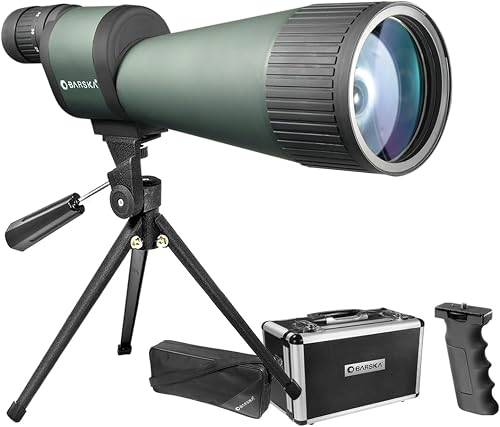
- Objective lens 88 Mm
- Field of view 1.7 Degrees
- Focus Manual Focus
- Dimensions 3.75 X 3.75 X 13 In
- Weight 16.0 lb
The Barska AD11334 uses an 88 mm objective, the largest in any scope under $135 on this list, and pairs it with a field of view of 1.7 degrees and a weight of 16 pounds, making it a bench or fixed-position scope rather than a carry scope. At $131.06 and 801 reviews at a 4.0-star rating, it has strong demand validation and gives the buyer the maximum aperture available at this budget. The manual focus and large aperture suit low-light conditions when the scope is set up on a solid mount. Buyers who do not need to carry the scope and want the most light-gathering aperture for the money will find this compelling.
Best for: Fixed-position observers, window-mount users, and anyone who wants maximum aperture on a tight budget and will not be moving the scope often
Pros
- 88 mm objective is the largest aperture available under $135 on this list
- 801 reviews at 4.0 stars confirms real-world usefulness
- Field of view of 1.7 degrees is useful for fixed observation stations
- Manual focus keeps the design simple and low-maintenance
- At $131.06 the price-to-aperture ratio is the best on the entire list
Cons
- At 16 pounds it is a bench or tripod-only scope, not suitable for backpacking or field carry
- 4.0-star rating is solid but lower than the top picks
Bottom line: If aperture per dollar is your priority and portability is not, the AD11334 offers an 88 mm objective at a price no other scope on this list can match.
Check price on Amazon Read the full review →
- Objective lens 80 Mm
- Field of view 1.74 Degrees
- Focus Manual Focus
- Dimensions 17.71 X 6.89 X 4.72 In
- Weight 2.4 lb
The Gosky 3216577988 packs an 80 mm objective, a field of view of 1.74 degrees, and a 4.3-star rating from 566 reviews into a $169.99 package that weighs 2.4 pounds. The manual focus and compact dimensions at 17.71 by 6.89 by 4.72 inches make it practical in the field rather than just on a bench. At under $170 with a large-aperture 80 mm objective and more than 500 reviews, this Gosky model fills the gap between the entry-level budget picks and the step-up Vortex options for buyers who want 80 mm capability without reaching $300.
Best for: Buyers who have outgrown sub-$135 options and want an 80 mm aperture without crossing $175
Pros
- 80 mm objective with a field of view of 1.74 degrees at a sub-$170 price
- 566 reviews at 4.3 stars gives meaningful buyer confidence
- 2.4-pound weight is comfortable for field carry
- Manual focus is reliable and straightforward for most conditions
- Sits between the budget and mid-range tiers, filling a practical price gap
Cons
- Magnification range not listed in spec data; verify before purchase
- Build quality will not match the Vortex options at higher prices
Bottom line: The Gosky 3216577988 is a practical bridge between budget and mid-range, giving you a large objective and strong buyer confidence at a price point few 80 mm scopes can match.
Check price on Amazon Read the full review →Buying guide
Objective Lens Size: The Spec That Matters Most
The objective lens is the large front glass that gathers light, and its diameter in millimeters is the single number that most predicts image brightness. A 50 mm objective works fine in full daylight at moderate distances, such as a 100-yard target range or a bird on an open meadow. Bump to 60 mm or 65 mm and you gain meaningful improvement in dawn and dusk performance. An 80 mm or larger objective is the choice for glassing distant ridges in low light or extracting fine feather detail on a bird 200 yards out. The tradeoff is weight and bulk: an 80 mm body is noticeably heavier than a 50 mm one, so think about how far you plan to carry it. Most serious buyers who want one scope to cover multiple uses land on 65 mm to 80 mm as the practical sweet spot.
Magnification: Fixed vs. Zoom and How Much You Really Need
Spotting scopes come in fixed magnification and variable zoom versions. A fixed 40x or 60x eyepiece is simpler, holds collimation well, and typically delivers a brighter, sharper image at that one power than a zoom does at the same setting. Zoom eyepieces starting at 20x let you find a subject at lower power before cranking up, which is practical for hunting applications or birding where subjects move. The 20x to 60x zoom range covers the vast majority of use cases from a stable tripod. Beyond 60x, atmospheric shimmer usually degrades the image faster than additional magnification helps, so claims of 80x or 100x on budget scopes are largely marketing. For most buyers, a scope that delivers clean, contrasty images at 30x to 45x is more useful than one that theoretically reaches 60x with a soft, dim picture.
Angled vs. Straight Body: Which Configuration Fits Your Use
Straight-body scopes keep the eyepiece in line with the objective, which makes tracking fast-moving subjects and sharing a field position with a shooter natural and intuitive. Angled bodies position the eyepiece at 45 degrees, which is easier on the neck during long observation sessions, works well on a tripod when multiple observers of different heights share the scope, and allows the scope to sit lower on the tripod head for better stability in wind. Birders and wildlife watchers who spend hours at a scope tend to favor angled. Target shooters who need to stay in a shooting position often prefer straight. If you plan to use the scope primarily from a vehicle window mount or on a fixed bench, straight is usually simpler. Neither configuration affects the optical quality of the glass.
Budget Tiers: What You Actually Get at Each Price Point
Under $150 you can find scopes with 60 mm to 80 mm objectives and 3,000 to 5,000 user reviews, which tells you a lot of buyers found them serviceable for casual birding, wildlife watching, or occasional range use. In the $150 to $350 range the build quality improves, armoring becomes more rugged, and optical coatings get better, reducing glare and improving color fidelity. From $350 to $700 you start seeing aluminum bodies, ED glass elements on some models, and brands with meaningful warranty programs. Above $700 the gains are real but incremental: better edge-to-edge sharpness, improved low-light transmission, and weatherproofing rated for sustained rain rather than just splashes. Flagship scopes from Swarovski, Leica, and Zeiss above $2,000 are priced for professionals and serious enthusiasts who use optics daily and can feel the difference.
Tripod and Mount: The Component Most Buyers Underestimate
A great spotting scope on a shaky tripod performs worse than a mediocre scope on a solid one. At 30x magnification, any vibration in the mount amplifies into a blurry, unusable image. Look for a fluid-head pan-tilt tripod rated for at least 1.5 times the weight of your scope. Most scopes in the 50 mm to 65 mm range weigh 1 to 3 pounds, but some 80 mm models with carbon fiber tubes come in under 2 pounds while others reach 3 to 4 pounds, so check the spec sheet. Quick-release plates that accept standard Arca-Swiss heads let you swap between a tripod, a window mount, and a hunting tripod without tools. Budget at least 20 to 30 percent of your scope spend for a quality tripod if you do not already own one.
Weatherproofing and Durability: What the Specs Actually Mean
Waterproof and fogproof claims on spotting scopes mean the body is sealed with O-rings and the interior is purged with nitrogen or argon gas. Nitrogen purging prevents the internal lenses from fogging in cold, wet conditions, which matters when you pull a cold scope into a warm blind or take it from an air-conditioned vehicle into humid air. True waterproofing is rated to a submersion depth, while water-resistant means only splash protection. Rubber armoring protects against drops and abrasion and also reduces cold-weather grip problems with bare metal tubes. If you use a scope year-round in the field rather than only on dry sunny days, pay close attention to these specs rather than assuming every scope is sealed equally well.
Common mistakes to avoid
- Buying the highest magnification number without checking objective lens size, which often results in a dark, shimmer-prone image rather than better detail.
- Skipping tripod budget entirely and then blaming the scope for shaky images that a better mount would have solved.
- Choosing a straight body because it looks simpler, then realizing hours into a birding session that an angled body would have saved significant neck and back strain.
- Ignoring field of view specs, which determines how easy it is to locate and track moving subjects at high magnification.
- Buying a 100 mm objective scope for backpacking or travel when a 60 mm or 65 mm model would deliver 90 percent of the performance at one-third the weight.
- Dismissing budget scopes entirely when high review counts (2,000 to 5,000) indicate real-world usefulness for the most common applications like birding, target spotting, and wildlife watching.
Frequently asked questions
What magnification do I need for a 100-yard target range?
For reading bullet holes on a standard 8.5 by 11 inch target at 100 yards, 20x to 30x is usually enough with a quality objective lens. You can push to 40x or 45x for smaller targets or tighter groups without significant atmospheric degradation in most conditions. Magnification above 45x at 100 yards rarely adds practical information and makes the image more sensitive to heat mirage, especially on sunny afternoons.
Is a 60 mm objective enough, or do I need 80 mm?
A 60 mm objective is plenty for daylight birding, 100 to 200 yard target spotting, and general wildlife watching when light is good. If you frequently use the scope in the first or last hour of daylight, or need to resolve fine detail at ranges beyond 300 yards, an 80 mm objective delivers noticeably more light-gathering ability and gives ED or fluorite glass more surface to work with. The 80 mm body is larger and heavier, so the trade is real.
Do I need ED glass in a spotting scope?
Extra-low dispersion (ED) glass reduces chromatic aberration, which shows up as color fringing on high-contrast edges like a bird against bright sky or a target on white paper. At magnifications below 40x most people do not notice the fringing strongly. At 50x to 60x on high-contrast subjects, ED glass makes a visible difference in sharpness and color accuracy. For casual or occasional use a non-ED scope at a lower price is a reasonable call. For serious birding, photography through the eyepiece, or daily field use, ED is worth the premium.
Can I use a spotting scope for digiscoping?
Yes, many spotting scopes accept an adapter that connects a smartphone or camera to the eyepiece for digiscoping. Image quality depends heavily on the scope's optical quality, the adapter's alignment precision, and how steady the tripod is during the shot. Scopes with larger objective lenses and better coatings produce better digiscoping results because more light reaches the sensor. Check whether the scope you are considering has adapter accessories available from the manufacturer or third-party suppliers before purchasing with digiscoping in mind.
How does field of view affect real-world use?
Field of view is the width of the scene visible through the scope at a given distance, usually stated in feet at 1,000 yards or in angular degrees. A wider field makes it easier to find and follow moving subjects like birds or game animals, especially at lower magnifications. At high magnification the field naturally narrows on any scope. If you spend most of your time scanning rather than staring at a fixed point, prioritize a scope with a wider field at its lower magnification setting rather than chasing the maximum power number.
What is the difference between a roof prism and porro prism spotting scope?
Most modern spotting scopes use a prism system to fold the optical path and correct the image orientation. Roof prism designs produce a slimmer, straighter tube and are easier to make waterproof. Porro prism designs use an offset layout that can offer a wider apparent field of view at a given price point. The practical difference for most buyers is mostly about body shape. At equal optical quality, neither design is inherently superior for field use.
How do I care for spotting scope lenses to keep them clear?
Use a soft brush or air blower to remove dust before touching the glass, since dragging grit across coatings causes micro-scratches. When cleaning is necessary, use a lens cloth or cotton swab dampened with lens cleaning solution made for coated optics, wiping in a spiral from center to edge. Avoid household glass cleaners, which can damage anti-reflection coatings. Store the scope with lens caps on, in a padded case, away from extreme heat sources like direct sunlight through a car window.
Final recommendation
The spotting scope market in 2026 spans a huge range from well-reviewed sub-$150 options that handle most daylight tasks to precision optical instruments above $2,000 built for professionals who notice every incremental image improvement. For most buyers, the sweet spot sits between $130 and $500, where an 80 mm objective, a 4.3 star or higher rating, and hundreds of verified reviews combine to deliver genuine value. Match objective size to your conditions, buy the best tripod your budget allows, and you will get years of reliable use out of any of the picks on this list. For specific questions, contact the VisionHut team at [email protected].